
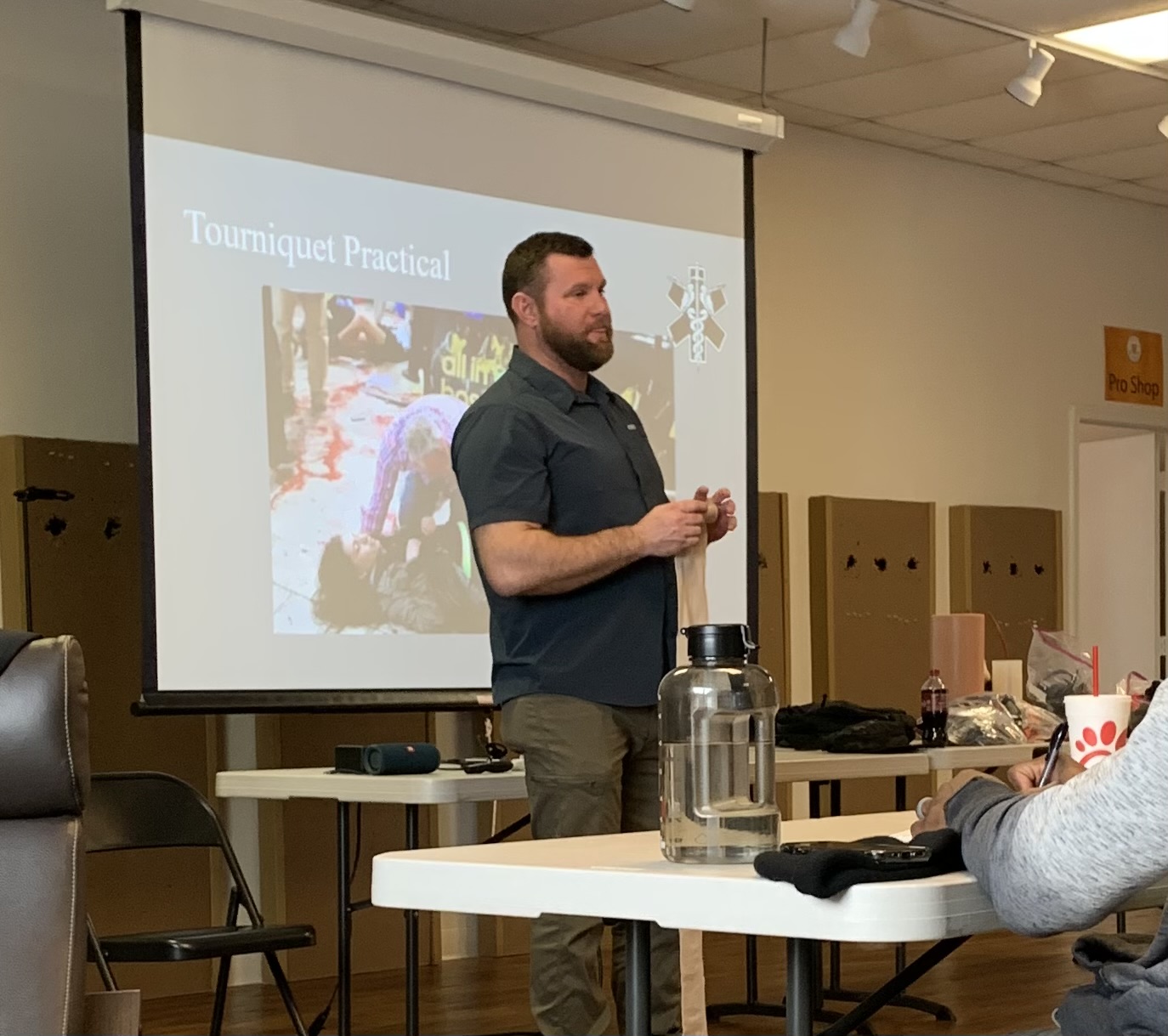
Green Ops is a training company founded by Mike Green, and it operates in Virginia and Texas. I know several of the instructors on his Virginia based cadre. I have done other firearms training with Green Ops in the past and I can assure the reader that their curriculum and their instructors are always excellent. Green Ops also contracts instructors for specialty offerings beyond the firearms focus, one such individual being David Lang, an instructor with his own company entitled Unicorn Tactics, a very experienced ex-military paramedic, who was the lead instructor for this class.
This was a single-day class on the M.A.R.C.H/TCCC subject. Regardless of how exactly they are branded or named, the primary focus of such a class is the emergency treatment of severe, life-threatening, hemorrhage. Beyond doing the usual CPR and Stop the Bleed courses, I have also taken multiple TCCC type classes, in both one and two-day formats. I think the one-day format does well to give civilians the essentials they need to treat emergency, on the scene, hemorrhage, which is a leading preventable cause of death related to accidents and violence.
Many people who take multiple firearms classes don’t see the point in taking multiple medical classes (outrageously, many have never taken a single medical class). Listen, if you took your last med class fifteen years ago, sorry, much of that knowledge is well out of date. Things change rapidly in medical best practices. Also, similar to taking multiple shooting classes, you always pick up new things from a new instructor, as each is unique in certain focuses and perspective. This class was a great example of that.
The class was held at a regional Rod and Gun club, in the clubhouse. It was a nasty, cold day with snow on the ground, so all scenarios and training were performed in the indoor classroom. The day ran from roughly 8am until 4pm. There were fifteen students in attendance, including myself, with three women present, the rest dudes, several of which I had met before in other classes. As usual, the select few who take personal responsibility for their own safety seriously.
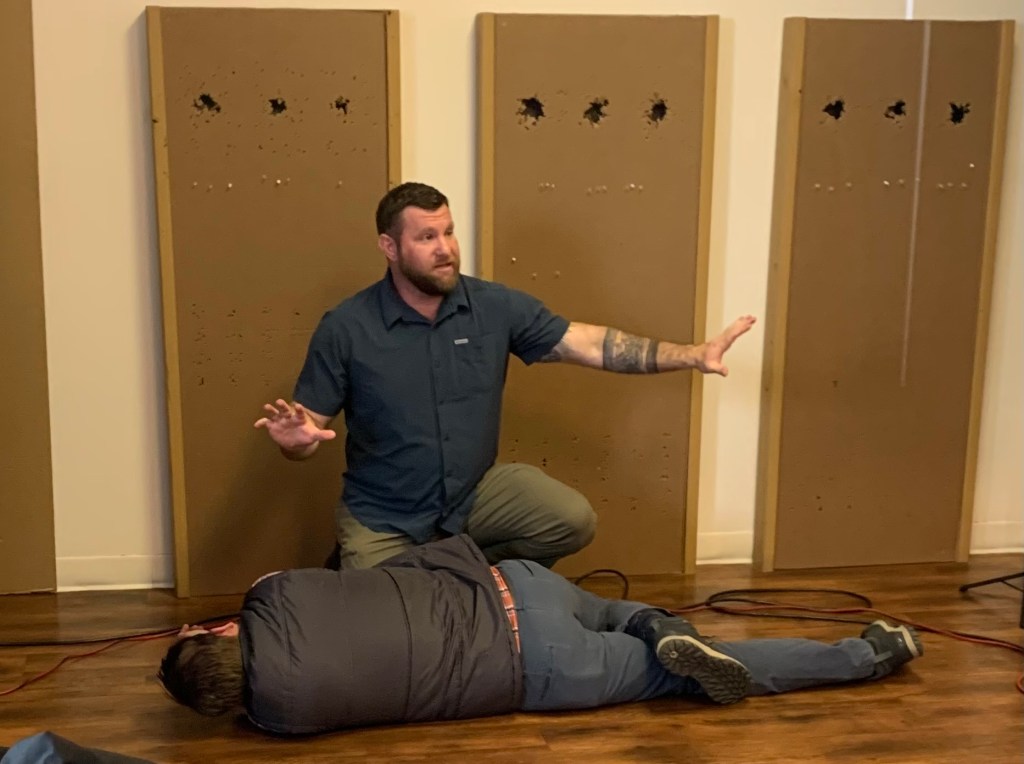
The class began with introductions, and David Lang provided an overview of his extensive experience in combat and elsewhere. He then went through a PowerPoint presentation that laid out the M.A.R.C.H algorithm, and specified that focus on massive hemorrhage and airway were the most important elements for the citizen, at the scene, who would provide aid. The class then proceeded throughout the day to address tourniquet application, pressure wrapping, wound packing, applying chest seals, and putting unconscious patients in the recovery position. Scene safety and patient assessment were also addressed, as well as techniques for moving casualties, and David addressed the mitigation of hypothermia as well. Most of the afternoon was spent working scenarios and doing hands on assessment and treatment with role players.
Rather than speak to all of the themes in this class, I will, instead, point out the takeaways that I found unique in terms of my own medical training thus far. First, while other classes I have taken, ranging from basic CPR to two-day TCCC/TECC type classes, talk about liability, they usually just mention the “Good Samaritan” laws, and that, as long as you stay in your lane, you are good to go. For example, no performing needle decompressions unless you have a level of certification for such. However, David was far more explicit about how precarious this can be. Essentially, performing anything that is invasive, including wound packing, can open the individual to considerable liability. Placing a tourniquet, a chest seal, or applying direct pressure, all strictly topical, is really where the citizen responder needs to stay with perfect strangers. Other techniques should be confined to your own people. A really valuable discussion, and a sad reminder of how litigious our society now is.
Another thing I took away from this class is the extensive usefulness of Ace Bandages. David prefers them over pressure dressings for that use. While they don’t incorporate a bleed pad, if already using gauze, the Ace Bandage provides excellent pressure, and it can also do other useful things, for a much smaller and cheaper footprint comparted to pressure bandages. David demonstrated how an Ace Bandage can tourniquet the limbs of small women or children, or pets, quite readily.
Pertaining to chest seals, David fully demonstrates their use, but does not place them high on the list of essentials for the average civilian in a suburban setting where medical help is only minutes out (this changes if in a remote setting, obviously). He explains that tension-pneumothorax takes long enough to develop that, when in places where responders are not far off, they are not likely needed. Comparatively, where arterial bleeding can kill in a few short minutes, tourniquets and packing gauze need to be instantly on hand. He suggests carrying a tourniquet, packing gauze, and an Ace Bandage in your essential on-hand bleeding kit.
I also really liked the demonstration and practice on putting casualties in the recovery position. David focused on doing a very fast triage of casualties in an event where there are many, helping those who can be helped, and placing unconscious individuals in the recovery position to help keep their airway clear. He also explained the benefits of keeping mylar blankets in a trauma kit, to prevent a casualty from going hypothermic, which can easily happen in even relatively warm weather.
So, overall, this was an excellent class. If you want to take a great TCCC style class in a one day offering, I don’t think you can do much better than this. Highly recommended. Thank you to David Lang for the excellent class, and thank you to Green Ops for hosting and arranging. For those anywhere close to Northern Virginia, this class seems to be offered through Green Ops once or twice a year, so get into it if you can.
 Reflex Handgun
Leave a comment