
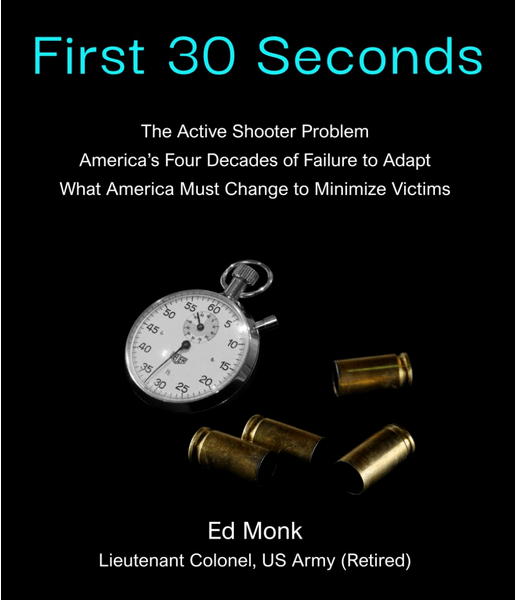
Ed Monk is a firearms instructor that has become the preeminent expert on the active shooter problem in the past several years. He has an interesting background for this expertise, being a retired military guy as well as an experienced public school teacher. I have listened to his presentations in the past as I very much appreciate his incredible insight into this trend of extreme violence we have been plagued with as a nation.
I recently grabbed the kindle version of Ed’s book, First 30 Seconds: The Active Shooter Problem, and read it. The truth is, being as familiar with his work as I am, much in the book corresponds to his talking points in his lectures, as is no surprise, and I was familiar with much of the material presented in the book. Even so, there was more detail in the book on certain topics that made it entirely worth reading, even for someone who has followed his work. I highly recommend picking up a copy if you take this threat seriously.
The book breaks down Ed’s ingeniously simple explanation of the active shooter problem: time and math. He provides examples of some extremely aggressive active shooters in our history, and it comes down to the simple fact that, unless the killer is met with force within the first 30 seconds, a double-digit body count is almost inevitable.
Much of the book focuses on Ed’s extensive work with schools, and the asinine resistance that administrators put up against taking any serious precautions. The school systems cling to the lock down approach, and Ed dissects the many deficiencies with this model, citing real world examples that point out the shortcomings of this method.
The book focuses greatly on preparation for schools, but he also discusses houses of worship, another target for such attacks in recent years. One of the best parts of this book is the deep dive into several of the major active shooter attacks in the past, offering details I have not heard elsewhere. The examples provided support the overall focus of the book: in events where the killer is met with violent resistance, quickly, the body count is low. Often, this has been unarmed resistance, or attack with weapons of opportunity, and has still proven successful. Comparatively, where shooters have faced no resistance for the first several minutes, the body count has been staggeringly high.
One of the best parts of the book is the debunking of what Ed calls “boogieman arguments.” These are the asinine arguments made by administrators, church leaders, and public officials, against having an armed security plan. If you deal with such as part of your role in any kind of administration, this section of the book alone is priceless.
I will keep this review brief and simply say that, whether Ed Monk’s work is entirely new to you, or if you have attended his lectures and listened to his information, the book has information in it that you probably have not heard before and it is well worth the read. Highly recommended.
 Reflex Handgun
Leave a comment