
In my youth the defensive firearms community still lived in the shadow of WWII and the 1911, in which, according to lore, the 45 ACP cartridge, fired from the mighty 1911, killed German soldiers with aplomb, whereas the 9mm fired at American GIs from German Lugers all but bounced off. We also lived in the aftermath of the 1986 Miami shootout which further solidified the deficiencies of 9mm in public memory. Back then, if you carried a 9mm you did not admit it. Rather, you discussed your custom 1911, or perhaps carried a new-fangled 40 S&W of some kind. Things have changed, drastically.
Today, the 9mm reigns supreme. Those in the know carry 9mm. Sure, some fudds will still talk about 45 ACP, only because they don’t make a 46, but the cool kids carry 9mm in polymer pistols. The advancement in bullet design has so closed the gap that now it has become almost irrelevant between service cartridges, as long as you select good bullet designs.
However, we now see many well-respected influencers in the gun community tout cartridges that, in decades past, were considered little more than insufficient mouse gun calibers. Again, with bullet development, the 380 ACP has gained much more respect. Likewise, other sub-service caliber cartridges have caught on in a big way of late. Even the 22 Long Rifle is found in revolvers that respected people actually carry. Who would’a thunk it?
So, what’s the deal with the mouse gun calibers being in vogue now?
This change in thinking and practice is not just based on the advancement of projectile technology and effectiveness, but is also the result of a far more studied approach. Handguns are simply not as powerful as rifles, and shots need to be places into vital areas to facilitate a rapid end to violent behavior. With this in mind, the simple fact that any projectile that can penetrate to the required depths of the human body, be it a 22 LR or a 45 ACP, can get it done, and any hits outside of these vital areas simply won’t finish the business, no matter the round.
Pertaining to revolvers, two advantages come from these sub-caliber rounds: first and foremost, they have far less recoil, leading to far better shooting performance for most. Even standard pressure 38 Special tends to be punishing from ultra-lite snubs. Second, you gain more capacity in a similar sized gun. Does seven or eight rounds of 22 magnum, with far less recoil, outclass five rounds of 38 Special?
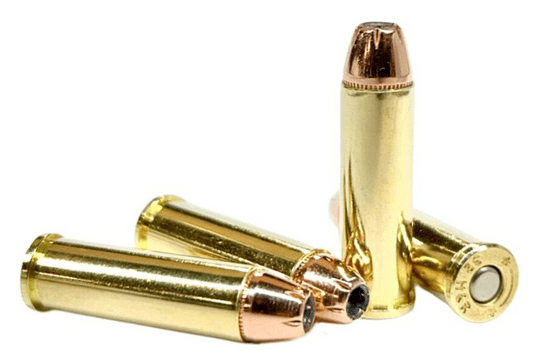
To my way of thinking, the cartridge that seems to make more and more sense in snub revolvers is the 32 H&R Magnum. This round typically flings a bullet between 80 and 100 grains in weight, at similar speeds to 38 Special, which uses bullets from 110 to 158 grains in weight. Needless to say, the 38 remains more powerful due to the larger and heavier bullet, but the 32 H&R typically penetrates to about the same depths with similar bullet designs.
The 38 does seem to provide better expansion in hollow points, but coming from snubs with two-inch barrels expansion is unpredictable at best, and you simply can’t count on reliable expansion from either cartridge. Therefore, penetration is king, and the 32 does penetrate. The bigger bullet is the better performing bullet if all else is equal, and will do more damage, but the ability to place more hits, rapidly, in vital areas, remains the most important ingredient in handgun effectiveness, and less recoil leads to better performance in this regard.
The even more powerful 327 Federal Magnum has as much, or more, recoil than 38+P, but the 32 H&R Magnum offers adequate performance at light recoil levels. Further, the 32 H&R significantly outclasses 22 Long Rifle or 22 Magnum out of similar length barrels, and it offers the reliability of center fire ammo. Also of note, when using rim-fire revolvers, you get an inherently heavier trigger pull due to the extra spring tension needed for these primers. 32 H&R Magnum offers more power, reliability, and a better trigger than the 22 options, yet with much less felt recoil compared to 38 Special. For these reasons, the 32 H&R Magnum cartridge seems to hit a Goldie Locks zone of just right in small revolvers.
The J Frame or LCR sized revolver, the definitive defensive wheel gun dimension, will have five rounds of 38, but six rounds of 32. The power difference between these cartridges, and the relevance of this power towards stopping violent hostility, is up for debate, but six rounds is, indeed, more than five, and more is better in terms of ammunition capacity in the gun.
The foremost downside to 32 H&R remains ammo price and availability, which will, likely, never quite catch up to what is available in 38 Special and 38 +P. Still, I think it has a lot going for it. I am not so worried about the difference between five more powerful rounds compared to six less-powerful rounds, but the recoil advantage is huge. Most shooters will, inevitably, shoot better with the 32 H&R Magnum in a similar sized gun compared to 38. Those who are not already avid revolver shooters will especially benefit from the recoil reduction.
Frankly, if I was starting over, I would likely invest in small-frame revolvers in 32 H&R. However, I tend to stick with what works once I invest, and I have been utilizing the 38+P Ruger LCR for many years now. The guns, the support equipment, and the ammo, is an investment. I won’t switch to something else at this point for my deep concealment/backup gun needs, and I will stick to the tried-and-true 38. However, I think that 32 H&R Magnum is worth a serious look if you are getting into small revolvers, especially if you are not fond of recoil. While ammunition remains more difficult to acquire, and more expensive than 38, you can also shoot 32 Long out of it, which is even more mild for practice. Thus, it is a versatile chambering.
The gun I would recommend would be the Ruger LCR, either the heavier one chambered in 327 Federal Magnum, but you can shoot H&R Magnum out of it, or the new light weight variant chambered specifically in 32 H&R. Smith and Wesson offers several models now chambered in 32 H&R, but quality has been spotty. Hopefully this will improve, but for now I recommend the LCR models. Of course, I am partial to the LCR, as you already know.
For the best prices on ammunition, shop Ammoman.com https://www.ammoman.com/
For the ammo I use for training, go to: https://www.ammoman.com/9mm-blazer-brass-124-grain-fmj-5201-1000
 Reflex Handgun
I have heard more and more people in recent years recommend cartridges such as 380, and 32 h&r. I remember a time when this would have been unthinkable. Frankly, I find it refreshing. To me the two most important elements of concealed carry are having your firearm with you, and being able to hit a target with proficiency. That’s where these smaller calibers really shine. I know this is a controversial statement, but I truly believe that many people would be better served carrying a pistol chambered in .22 lr, rather than something chambered in 45, or 357. A snub nose revolver chambered in a soft shooting cartridge is a great companion. Like you, I have already invested far too much money in 38 ammo to consider anything different at this point. Also, the ammo shortage which occur during covid would make me a little hesitant to build a weapon system around a niche cartridge like 32 h&r. But if I could do it all over again, it would certainly be in the running.
LikeLike
I agree completely. I think as we have learned that shot placement is what truly matters we realize about any cartridge works or fails based on what is hit. I am at the point where I would not be too worried about carrying a 22lr snub, 8 rounds of Federal Punch can accomplish a lot.
LikeLiked by 1 person