
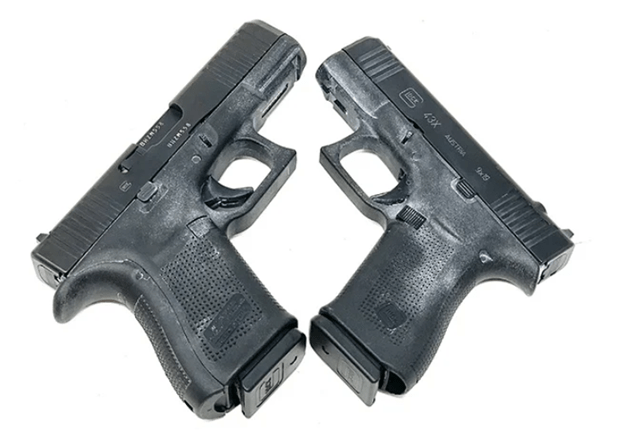
We have all heard the advice to “carry as much gun as you can,” or “carry the biggest gun you can,” and the like. There is obvious merit to this sentiment, as generally larger pistols are more capable and more shootable. However, there are variables and there is nuance. For example, most modern shooters can probably shoot a micro 9mm better than a large Smith and Wesson 686 revolver. Similarly, a larger gun chambered in a more powerful round may give any particular shooter a harder time than a smaller gun chambered in a lower recoiling round. So, there is no hard and fast rule to be had concerning this sentiment.
Let’s make things simple: almost all shooters will get better performance from a Glock 17 than a Sig P365, that should be obvious. What also should be obvious is that the P365, or other similar guns, can be concealed in almost any attire, and for most people, a Glock 17 cannot. But what about guns that are more comparable? Does going bigger always make sense, if possible? For example, what if we compare the significantly larger Sig 365 Macro to a Glock 17? Many would find they get slightly better performance from the still larger G17, but is that necessarily the rule? How much difference? Have you tested it? And, at what point is the performance difference negligible, yet the concealment difference significant?
In our contemporary world, concealment is extremely important. You don’t want to be made as concealing a gun. often it is argued that “the general public does not notice concealed guns.” Sure, but cops and criminals notice. Concealed should mean concealed. With this in mind, perhaps the saying should be, “carry the biggest gun that you can adequately conceal.”
How much capability and performance do you actually sacrifice by going with a gun that you can adequately conceal over a full-size service pistol? For most people, the answer is, “I don’t know.” Until you actually put it on the timer to compare speed, and put it on the bullseye to compare raw accuracy, you don’t know. You may find that the difference is great, or negligible. You won’t know until you test it.
Consider the minimum standards you are willing to accept in your performance with a defensive handgun and then determine if you can meet them, or not, with a smaller, concealable, pistol. As an example, if you want to be sure of significant competence with the pistol, can you make the universally suggested standard of an A zone hit, at seven yards, from concealment, in 1.5 seconds, with said gun? Can you keep your rounds in an eight-inch circle at twenty-five yards with that gun? Can you keep your rounds on a C zone sized target at fifty yards with it? If you can meet such a standard with the small gun, then you need to consider whether any increase in performance from a larger gun outweighs the concealment advantage.
To truly know how much performance and capability you sacrifice by going to a smaller gun you must put it to the test. If the difference is great, you may need to work harder to conceal a larger gun. However, if the difference is negligible, I think there is a good argument in favor of much better concealability versus marginally better performance. Test and decide.
 Reflex Handgun
Leave a comment