
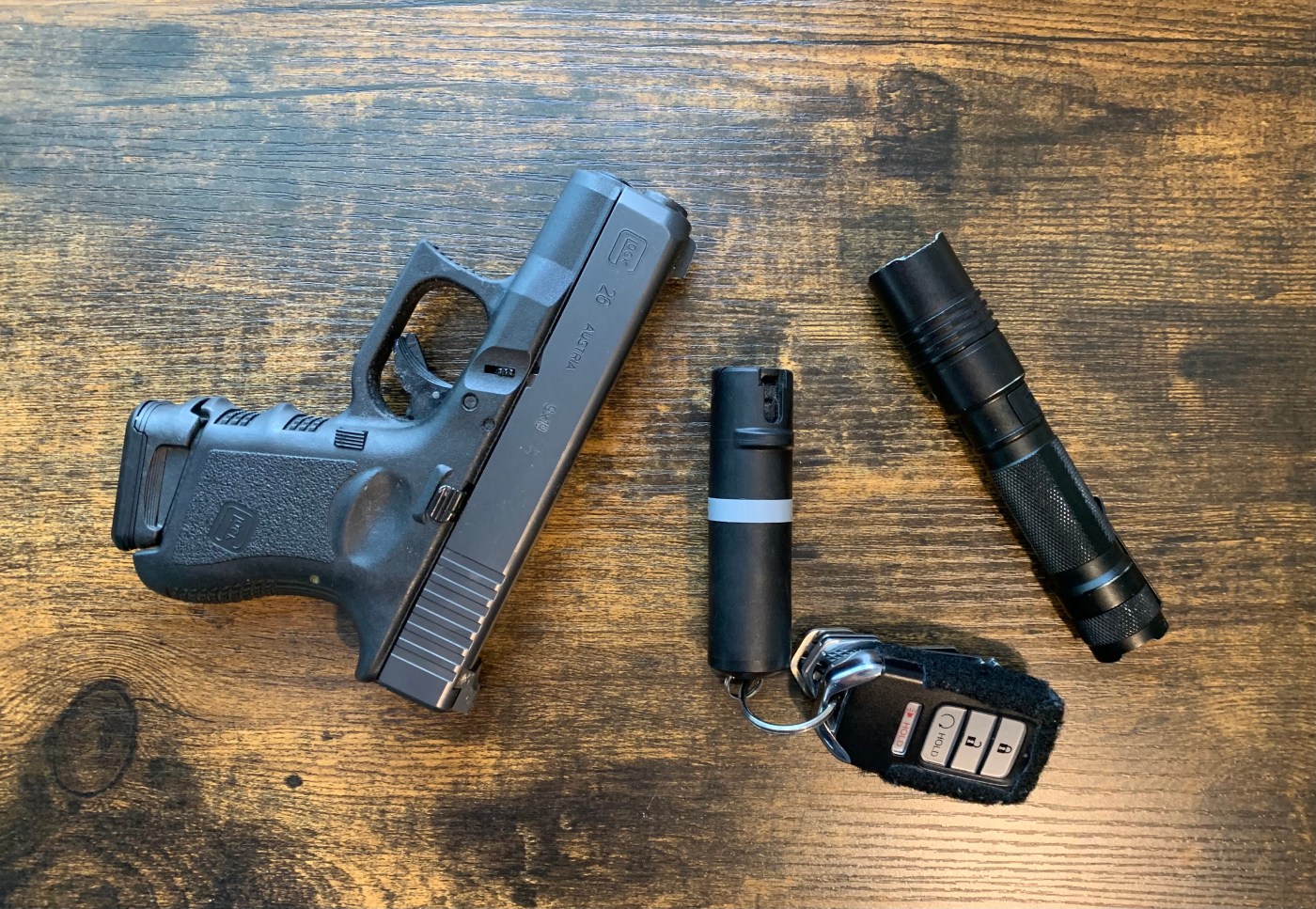
I have written before, expressing my belief that the three most valuable defensive tools for the armed citizen self-defender are the handgun, OC Spray, and a powerful handheld flashlight. I stand by that assessment. The other two categories of common self-defense tools that are omitted from my proposed three tools are, obviously, blades and impact tools. Since I am asked about this opinion, I will answer as best I can. Here is my thinking on this:
A blade is a viable, secondary, lethal tool, and an important preparedness tool in general, but it factors into self-defense to a greater or lesser extent based on individual preference and training. If given the choice to deal with a lethal threat, using a blade rather than a handgun would be absurd in most circumstances, with an exception for when the gun can’t come out, but the blade can, due to proximity in an entangled fight. There is also an arguable use of the blade over a gun due to the environment and a risk of misses or over-penetration being dangerous to others. These two scenarios are not very common in civilian self-defense; certainly possible, but not common.
Similarly, impact tools have a role, but are limited in the daily life of most concealed carriers. There are two issues that plague impact weapons: first, they are more heavily restricted than blades, or even firearms, in most places. This is absolutely absurd, but it is true. If risking a felony charge to carry a defensive tool, why would you opt for the impact tool? If in an environment where blades and firearms are absolutely verboten, but impact tools are legal viable, then certainly carry one. However, in the continental United States, impact tools are very over-regulated. Also, the issue I take with impact tools is that they blur the lines of lethal versus less-lethal force, and can fall into either category, depending on the use.
The big three seem to have no substitute. The handgun’s role in self-defense should be self-evident; it is a lethal projectile weapon, allowing for the neutralization of lethal threats that are beyond contact distance. OC spray, likewise, is a distance weapon, allowing for dissuasion of less-lethal threats beyond contact distance. Dealing with a threat, lethal or less-lethal, while still beyond contact distance, is ideal. The light supports both weapons in darkness, provides a solid impact tool if built correctly, yet not regulated as dedicated impact weapons are, and proves infinitely useful far beyond the scope of self-defense. The light also proves to be a tool that projects, as to dissuade bad actors at a distance.
Thus, the big three of civilian self-defense all facilitate the dissuasion of criminal assault while beyond contact distance, and the benefits of such should be obvious. A blade is extremely lethal, though the limitations of its ability to stop aggression quickly are well known, but the blade must be used at contact distance. Violence at contact distance dramatically increases the danger to the self-defender. Likewise, saps, blackjacks, or other impact weapons, must be used at contact distance.
With these parameters considered, it is the opinion of this author that impact tools and blades should be worked in, as needed, for various circumstances where they serve as a stand-in for the primary three tools referenced here, such as times where you can’t carry a gun due to legal or environmental restrictions, but you can carry a blade or an impact tool. If you are not restricted in what you carry in a given environment, I believe that the handgun, OC Spray, and a handheld light, are the primary defensive toolset. A knife should always be carried, though it is likely far more important as an emergency cutting and rescue tool than as a weapon.


Leave a comment