
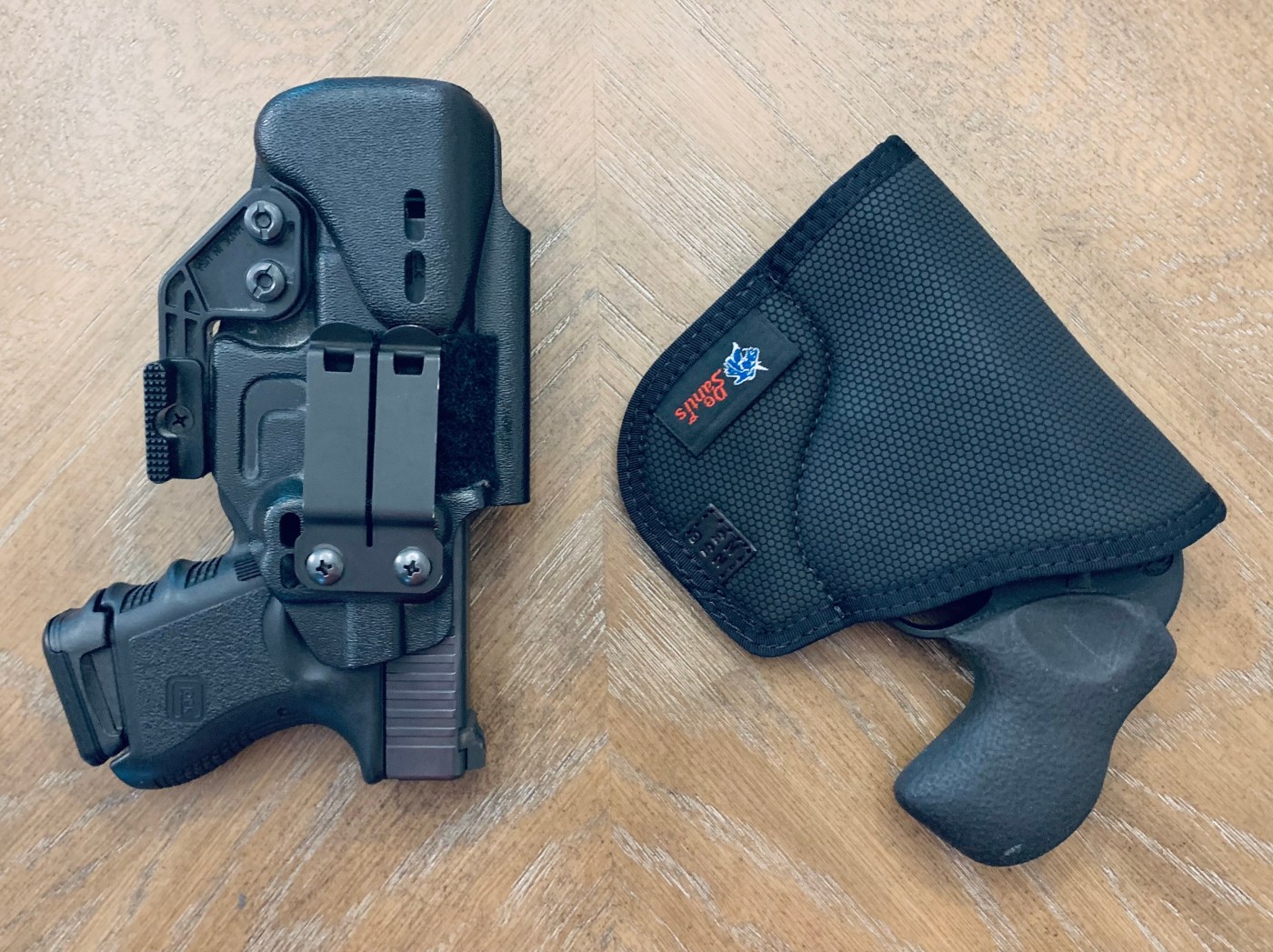
There are two quips in the firearms world that I absolutely disdain:
First, this gem of institutionalized stagnation: “slow is smooth, smooth is fast.” Say what, now? Slow is slow. The intended meaning behind this is probably better explained as, “efficiency of movement leads to speed.”
The second quip that I hate even more is: “a handgun is only for fighting to your rifle that you should have never left behind.” I see. While it sounds cool when the sleeve-tat bros say it, what does that mean? Do these guys actually envision a running gun battle in which they are shooting it out with the zombie bikers in a blitz towards their gun safe?
So, tell me, what good does your rifle that your handgun is only used to “fight to” do you when it is locked in your safe at home, twenty miles away while you are at the Piggly Wiggly? Further, for the “truck gun” bros, (most likely also with sleeve-tats) what good does the truck gun do you when you are inside of the Piggly Wiggly and the gun is in your vehicle in the parking lot and the threat is right in your face? This asinine saying hangs on because everyone realizes that a rifle is vastly more capable in accuracy and ballistic capability than is a handgun. That’s fine, BUT YOU WON”T HAVE A RIFLE WITH YOU!
As an armed citizen, you will fight with the handgun that you are, hopefully, wearing. Yes, I understand that your confidence is in your rifle after you took that carbine class with the ex-Delta guy, but you won’t have that when you face violence in a public setting. By the time you “fight your way to the rifle” the fighting will be long over, with either your demise or the demise of the adversaries. Get good with your pistol.
Now, before the gnashing of teeth begins, “how can you go against bad guys with rifles with only a handgun,” I suggest, again, that you get good with your pistol, and neutralize the baddies with rifles with that pistol like has been done successfully many times already. Check out my article on sixteen examples of good guys with pistols successfully eliminating bad guys with rifles, sometimes even multiple armor-clad bad guys, and living to tell the tale, in most instances without even getting injured. It turns out, bad guys are still just as susceptible to handgun bullets when holding a rifle as when not. It also turns out that mass killers always anticipate no resistance, not getting shot in the face by a concealed carrier.
I am not trying to make light of this and suggest that going against rifle-armed killers with a pistol is an easy task, but it has been done successfully many times because the dynamics of such engagements favor the defender even when the aggressor has ballistic superiority. The fact is, you will not have a rifle with you when you need it, no matter how much more confident you are in your ability with your rifle than you are with your pistol. Certainly, keep a fighting rifle ready in the home, and in some environments, maybe in a vehicle, but understand that it is highly unlikely that you will be able to access it when facing violence in public. The primary defensive weapon of the citizen, and even the uniformed cop most often, is the handgun.
With that said, consider what you are carrying, understanding that it is the only gun you will have if facing violence when out in public places. Although many sources indicate a recent drop in overall homicide throughout the nation, there is no denying the increase in the outlier events over the past several years. Active killers and multiple-assailant attacks are more prevalent and such adversaries warrant the carry of serious handguns. Therefore, I will again suggest my own standard that I stick to when setting minimums for a carry gun; I prefer a gun with at least ten rounds of capacity (doable even in the commie restricted states), and I like to be capable of putting 5-for-5 rounds in an eight-inch circle at twenty five yards, and five-for-five rounds on a C zone target at fifty yards, all at a realistic, condensed timeframe. I think that is obtainable and a good standard of realistic accuracy. Carry a gun you can consistently do that with and train with it.
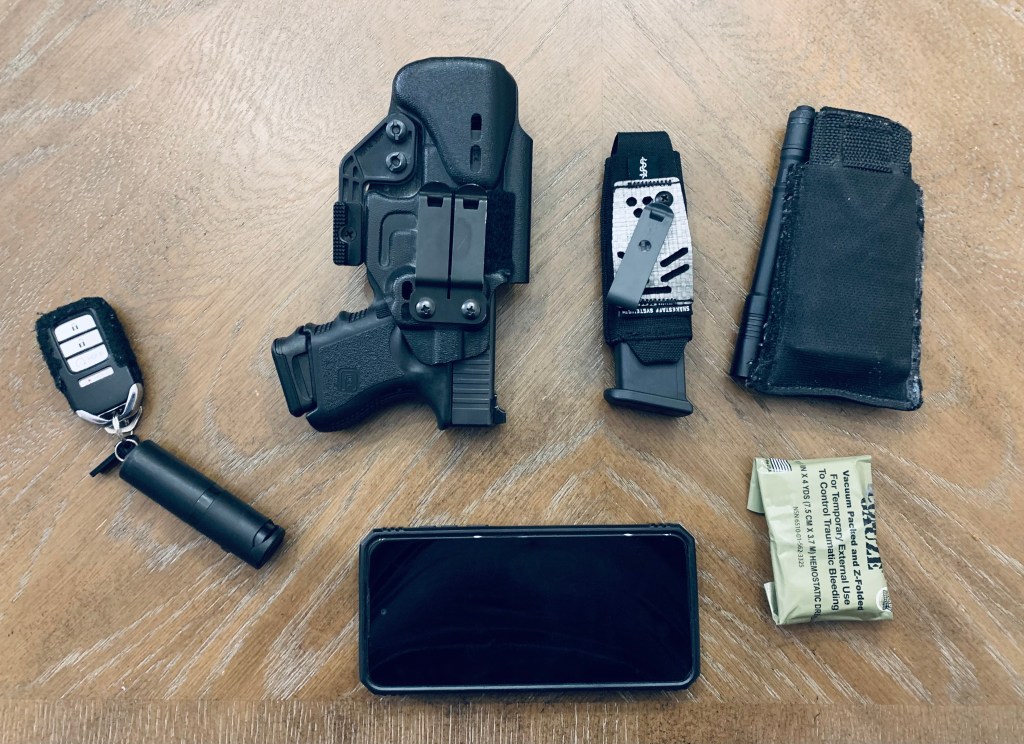
Further, consider the principle of fighting only with what is on your body and apply it to the other essentials, such as medical. While I keep a full trauma kit in my EDC sling bag, which I don’t always have actually on my person, and large trauma kits in the vehicles, I always carry a tourniquet and hemostatic gauze, in my assessment the two most essential trauma tools, on person. I don’t get along with ankle IFAKS, so these two tools live in pockets without much trouble. I urge you to carry at least a tourniquet on person, and if you can fit it, packing gauze as well. Certainly have chest seals and pressure dressings also available in your packs and vehicles, but I think at least a tourniquet on-person is a sound decision.
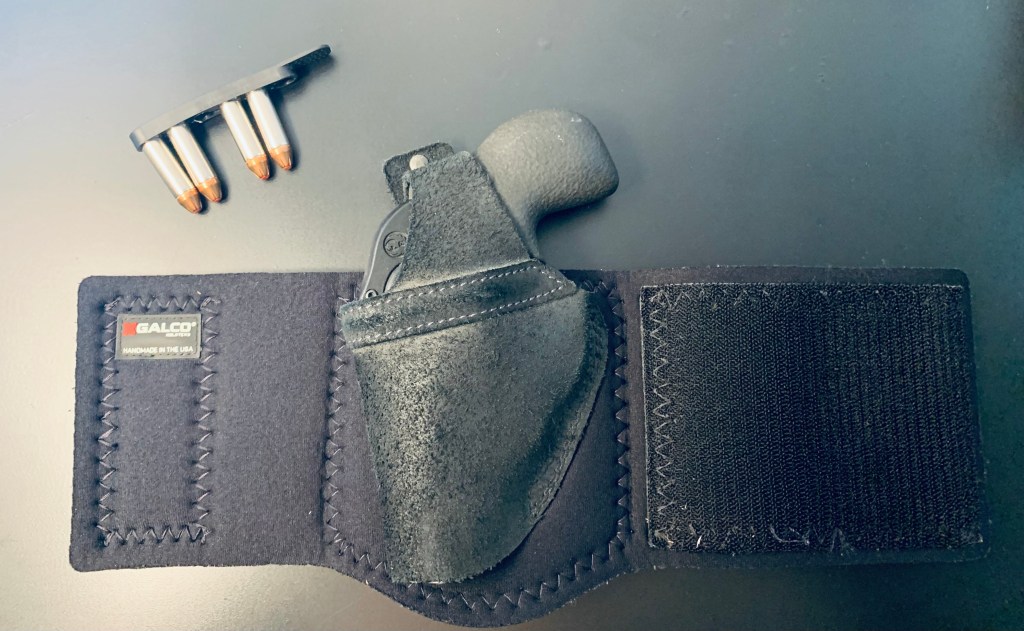
Finally, as we face a changing, and unfortunately deteriorating, future, I stress that carrying a capable handgun at all times possible is of the utmost importance. Along with this, a tool that may be of value for those with family in tow when in public is a backup gun. The primary benefit of a backup gun for a civilian is the ability to arm a friendly who does not carry themselves. I will submit that a backup gun, carried on your ankle or in a pocket, that you can hand to an older and trained child or to a significant other, is of far greater use than a rifle in the trunk. When violence happens, it happens fast. The handgun can stack the deck in your favor even in the face of seemingly staggering odds, as it has many times. Train with it.


whoah Sal! Take it easy on the sleeve tat bros…we are not all bad! I’d encourage you to keep a chest seal on you, especially if you already have hemostatic gauze. MOST Americans have more trunk surface area than limbs, and thoracic injuries in the civilian space are common with penetrating injuries. Yes, you can improvise if you must, but placing a chest seal and then placing the patient in a position of comfort or into a recovery position with the injured side elevated is ideal, especially when there are multiple
wounded.
I agree with everything else you wrote. I have a carbine…it’s in my safe. But luckily I’m keen with my pistol, my ankle gun and my sleeve tats. 😉
LikeLike
Sherman,
I rag on beards too and I have one, so it’s nothing personal! A guy who can shoot a handgun like you can have sleeve tats I suppose. It’s some of those other guys, though….
Yeah, chest seals, not easy to improvise, I always have them in my packs and vehicles but I just never get along with ankle IFAKs no matter how I try. Ironically, I find an ankle gun in a Galco perfectly comfortable but never find an IFAK that I can tolerate for more than a few days of trying it out.
LikeLiked by 1 person
I don’t ankle IFAK either but I DO use a pocket sleeve for the wound packing and chest seals.
Thank you for your kind words! Keep on writing!!!
LikeLike
The Internet is full of awful, wildly unrealistic preparedness advice. I’ve heard self defense bloggers refer to handguns as “niche guns” and argue that they are only relevant in a small set of circumstances and that your training should focus on your rifle. However that small set of circumstances is basically every day life for civilians. If you are going into battle then yes, rifles are very relevant. But chances are you’re not. You’re going to the grocery store and then to drop your kid off at swimming lessons. In that world (everyday life for most people) a hand gun is far more relevant. Just one additional point to mention. If you do plan to use your pistol to fight back to your rifle, (eye roll) please make sure that rifle is at home locked in a safe, and not left unattended in a vehicle. A truck gun sounds cool online, but is an awful idea in reality.
LikeLike
I agree with your assessment on truck guns, for most people it is primarily a theft waiting to happen. I suppose if you install a decent long gun safe into the vehicle, but again, if it is in the vehicle in the parking lot it might as well be on the moon. You won’t get to it.
LikeLike