
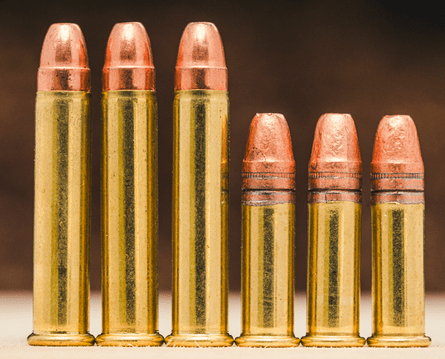
Ah, yes, the venerable 22 Long Rifle. I shot my first ground hog with that cartridge. Growing up in rural farm country, there was no end to the critters that were dispatched with rifles chambered in 22 Long Rifle. Despite the small projectile, typically something in the 36-40 grain range, 22 Long Rifle is surprisingly lethal when fired from a rifle-length barrel. The 22 Magnum, consisting of a longer case and a significantly higher powder charge, is far more powerful, again, from a rifle-length barrel. Honestly, I think one would be hard-pressed to think up a defensive scenario typical of civilian life that could not be readily handled with an auto loading rifle chambered in either cartridge, if the rifle is reliable.
However, when we drop down to two-inch barreled handguns, the impressive velocities that make these tiny bullets surprisingly effective greatly dissipate. A 22 rifle may prove an excellent choice for home defense for an individual who is not dedicated to any amount of training, but when we step down to handguns we need to approach this subject with careful consideration.
There is no denying that 22 Long Rifle, and certainly 22 Magnum, remain incredibly lethal, even from short barrels. However, when we return to the primary mission of the defensive handgun, we remind ourselves, the goal is to neutralize a deadly threat as rapidly as possible. Can that be done as effectively with a rimfire pistol as it can be with a service caliber?
When we discuss such matters we must lean towards the worst-case-scenario, which is facing a determined attacker, or attackers, who chooses not to stop, and the only way to force a stop is through dramatic enough blood loss that the individual de-pressurizes to the point of incapacitation, or through a disruption of the central nervous system. Clearly, service calibers offer both significantly more penetration and much more tissue destruction for accomplishing this. Still, 22 Long Rifle, and certainly 22 Magnum, with proper ammunition selection, can reach vitals. So, if utilizing these rimfire cartridges for defensive purposes, what are the benefits that offset the obvious ballistic inferiority?
The most obvious advantage is mitigation of recoil. These rimfire rounds offer almost no recoil even in tiny mouse guns. The ability to hit with more speed and accuracy is more important than the ballistic capabilities of the round. The second advantage is capacity: when compared to centerfire chambered guns of the same size, 22s will usually hold more rounds. A third advantage, especially regarding 22 LR, is cheaper ammunition compared to any centerfire round. A fourth advantage, again especially for 22 LR, is the lack of blast and noise.
What are the disadvantages? Obviously, the significantly less ballistic power. Beyond that, however, is also the fact that rimfire is less reliable than centerfire cartridges concerning consistent ignition, and it is also much dirtier ammo.
Frankly, I am not sure if there is any auto loader chambered in rimfire that I would trust for defense because they don’t seem to generate enough force on the firing pin to reliably ignite the tough rimfire primers. If I were to carry a rimfire handgun for defense it would strictly be a revolver, as revolvers provide a much greater level of force onto the firing pin. Which leads to one of the biggest downsides of rimfire for self-defense:
Take any revolver that has both centerfire and rimfire variants, and the rimfire will always have a significantly heavier trigger pull. How heavy? I think heavy enough to offset the low recoil advantage for most individuals who need that advantage. If you don’t have the hand strength to handle the recoil of anything more than rimfire, I doubt you would have the strength to manipulate such a heavy trigger pull. As an example of how much heavier these rimfire triggers tend to be, the Ruger LCR, which has one of the best out-of-the-box revolver triggers, comes in around 9-10 pounds on the centerfire options. On the rimfire models, they are often over 14 pounds. That is a huge difference.
I believe that rimfire has a place in defensive pistols, but it is a niche. The reduced ballistic performance is only one of the downsides. For example, if the Ruger LCR 22 Magnum model had 8 rounds, as does the 22 LR model, rather than the 6 rounds it has, which only gives one additional round over the 5 shot 38 and 357 models, and if it had the same trigger pull, I would, honestly, prefer it over a centerfire option. But between the heavy trigger pull and the marginal increase in capacity, I see no point. I think the 6 round LCRs chambered in the 32 calibers are more attractive options as they provide centerfire reliability and trigger pull. However, you then inherit hard to find, and very expensive, ammo.
If a rimfire revolver works well for you, I would not worry about it, just get good with it so you can truly place the shots where they need to go; that applies to all handguns anyway. For myself, I stick with 38 Special and 38 +P, and for less recoil in the lightweight guns I use wadcutter rounds for practice. To each their own.


Leave a Reply